
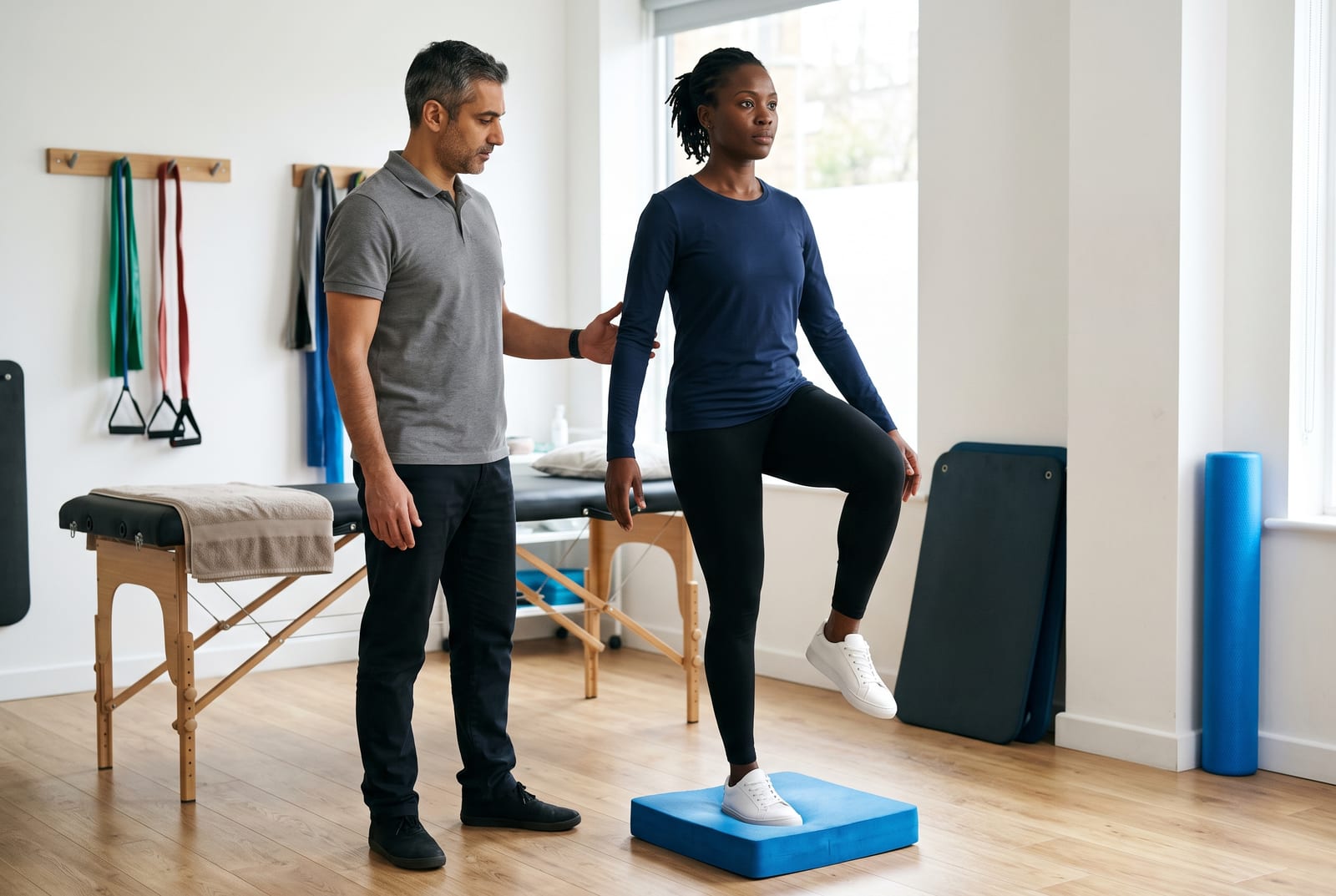
Yes, for most active people balance training measurably lowers the risk of an ankle sprain, and the effect is strongest if you have sprained that ankle before. Programs built around balance work cut sprain rates by roughly a third to a half in trials. The catch is that the benefit only shows up if you keep doing the work for weeks, not days.
How much does balance training actually reduce ankle sprains?
The numbers are fairly consistent across reviews. A meta-analysis of 30 studies (24 of them randomised trials) found that neuromuscular training programmes reduce ankle sprain recurrence risk by roughly 50%. The same review made a useful point: only programmes that included balance training showed a preventive effect.
Other reviews land in the same range:
- In soccer, programmes focused on balance training produced a 41% reduction in ankle injuries per 1,000 hours of exposure compared with control programmes.
- Earlier pooled data found balance training on its own reduced ankle sprain risk (RR 0.64), and a later review across sports found a similar result (RR 0.62, five studies). An RR of 0.62 means about 38% fewer sprains.
One honest caveat: some of these pooled estimates rest on a small number of studies. The Journal of Physiotherapy review notes that some of the earlier meta-analyses were each based on only two studies. The direction of the evidence is clear. The exact size of the benefit is less certain.
Does it matter if I've sprained my ankle before?
A lot. A previous sprain is one of the biggest risk factors for the next one. The research above notes a high risk of reinjury over the following 12 to 24 months, with chronic pain or instability developing in 20 to 50% of cases.
That is also the group that gains the most. A systematic review in the Journal of Athletic Training found that balance training substantially reduced ankle sprain risk, with a greater effect in people with a previous sprain. Ligament injury disrupts the position sense and reflexes that keep the ankle centred, and balance work helps retrain them.
Can I do it at home without a physical therapist?
The best single trial on this says yes. In a randomised trial of 522 athletes aged 12 to 70 who had sprained an ankle in the previous two months, one group added an eight-week, unsupervised, home-based proprioceptive training programme to usual care. Over the following year, 22% of the training group had a repeat sprain, compared with 33% of the control group.
A physical therapist is still worth seeing if the sprain was severe, if the ankle keeps giving way, or if you are not sure whether something is broken. They can also set the starting level so you progress safely. If you are still in the first few days after an injury, start with our guide to the RICE approach and let the acute swelling settle first.
What does a good ankle balance program look like?
Researchers have not agreed on one best recipe. A 2026 review in Frontiers in Physiology notes that the specific exercises and the optimal dosage of neuromuscular training are not yet well established. What the successful programmes share is a simple structure: short, regular sessions that get gradually harder over about eight weeks.
A progression you can follow
Move to the next step only when you can hold the current one for 30 seconds on each leg, without grabbing for support or putting the other foot down.
- Single-leg stand on a firm floor, eyes open, knee soft, near a wall or counter.
- Same position, eyes closed. This is much harder than it sounds, because it removes the visual help your ankle has been relying on.
- Single-leg stand on a foam pad, eyes open.
- Foam pad plus a distraction: slow head turns, or catching and returning a light ball with a partner.
- Reaching drills: stand on one leg and reach the other foot forward, sideways and behind you, touching lightly and returning.
- Hop and stick (later stage only): a small hop forward or sideways onto the trained leg, landing quietly and holding for three seconds.
Train both ankles, not just the injured one. A practical starting point, rather than a proven dose, is about 10 minutes three or more days a week, which fits easily into a warm-up.
Quick self-check before you return to sport
- Can you stand on the injured leg, eyes closed, as long as on the other side?
- Can you hop on it ten times without pain or wobble?
- Can you change direction at jogging pace without hesitating?
If any answer is no, keep training before going back to full play.
Is a brace better than balance training?
Both work, and the evidence does not clearly favour one. A 2018 meta-analysis of three trials found that current evidence does not favour neuromuscular training over bracing for preventing recurrent sprains, and it advised clinicians to choose based on patient preference and their own expertise. In one Dutch trial of 384 athletes, bracing beat neuromuscular training for reducing how often sprains came back, though not how severe they were.
In practice many athletes use both. Balance training builds the ankle's own control over time. A brace adds outside support while that control is still being rebuilt, or during high-risk sports such as basketball, volleyball and trail running. Keep in mind that trials tested particular brace designs, and results from one design do not automatically apply to every sleeve or support. For more on what the research does and does not show, see our summary of the science.
A fitting tip if you add a brace
A brace only supports the ankle if it sits snugly without cutting off circulation. Measure or try it on once the early swelling has gone down, wearing the socks and shoes you actually play in. A brace sized on a swollen ankle will feel loose within a few weeks. Check that it stays in place through a few test hops and cuts, with no slipping, pinching or numb toes. The same checks apply to our BodyGuard compression ankle brace or any other support you choose. Wear it for training and play, and keep doing the balance work. A brace is there to support the ankle, and balance training is still what rebuilds its control.
The bottom line
Balance training is one of the best-supported injury prevention habits in sports medicine, especially after a first sprain. Ten minutes a few times a week, progressed over about two months, is a small price for cutting your re-injury risk. If your ankle keeps giving way despite that work, see a physical therapist for a proper assessment.