
For most athletes, one or two short sessions a week is enough. Programmes that include the Nordic hamstring curl roughly halve hamstring injuries, and low-volume versions build eccentric strength about as well as the original high-volume protocols. What matters most is doing the exercise steadily for months, not piling on reps.
Does the Nordic hamstring curl actually prevent injuries?
The strongest summary is a 2019 meta-analysis in the British Journal of Sports Medicine that pooled 15 studies and 8,459 athletes. It found that programmes including the Nordic curl reduced hamstring injuries by up to 51%, with a risk ratio of 0.49. When the studies at high risk of bias were removed, the risk ratio was still 0.55, so the effect does not depend on the weakest research. The pooled result held regardless of sport, sex, age or competition level.
Individual trials point the same way. In a randomised trial of 579 male amateur soccer players from 40 teams, players in the Nordic group had a markedly lower risk of hamstring injury than controls (odds ratio 0.28).
Two honest caveats:
- Most of the evidence comes from football and other sprint sports. If you are a lifter or a recreational jogger, the benefit is a reasonable extrapolation, not something trials have tested directly in your sport.
- Nobody is fully sure how it works. The exact protective mechanism is still unclear. The leading explanation is that it increases eccentric hamstring strength and muscle fascicle length, meaning the muscle gets better at controlling a load while it lengthens.
How many sets and reps do you need?
Less than many coaches assume. A 2020 systematic review in Sports Medicine compared high- and low-volume programmes. After interventions of six weeks or longer, both produced very large gains in eccentric strength, and the authors concluded that cutting the volume did not blunt the adaptations in strength or muscle architecture.
A randomised trial in female football players reached the same answer: the high-volume programme did not produce greater gains in strength, jump height or speed than a low-volume one.
There is a limit to what we can say, though. A more recent dose-response meta-analysis found no dose-response relationship between Nordic volume and strength gains, but rated the certainty of the evidence low to very low and declined to name an optimal dose. In plain terms: low volume appears to work, but nobody has proven the perfect number.
A sensible weekly template
This is a practical coaching template built around those findings, not a protocol tested in a single trial. Adjust it with your coach or physical therapist.
- Weeks 1 to 2: one session a week, 2 sets of 3 to 5 slow reps. Expect some soreness at first.
- Weeks 3 to 6: two sessions a week, 2 to 3 sets of 4 to 6 reps, as long as soreness has settled between sessions.
- From week 7 onward: one or two sessions a week, 2 sets of 4 to 6 reps, kept going year round, including in season.
Progress by controlling the descent for longer before you catch yourself, not by adding lots of extra sets.
Why does consistency matter more than volume?
Because the exercise only protects people who keep doing it. When researchers surveyed top-level clubs in the Champions League and the Norwegian Premier League, the programme was completed in full in just 10.7% of 150 club-seasons. The authors judged uptake too low to expect any overall effect on injury rates.
The usual complaint is soreness. Delayed-onset muscle soreness is often raised as a major limitation, especially when it gets in the way of high-speed running over the following days. That is one reason the Sports Medicine review suggested lower volumes may suit athletes better: they may improve compliance. A small dose you actually do every week beats an ambitious plan you drop in October.
How do you do a Nordic curl safely?
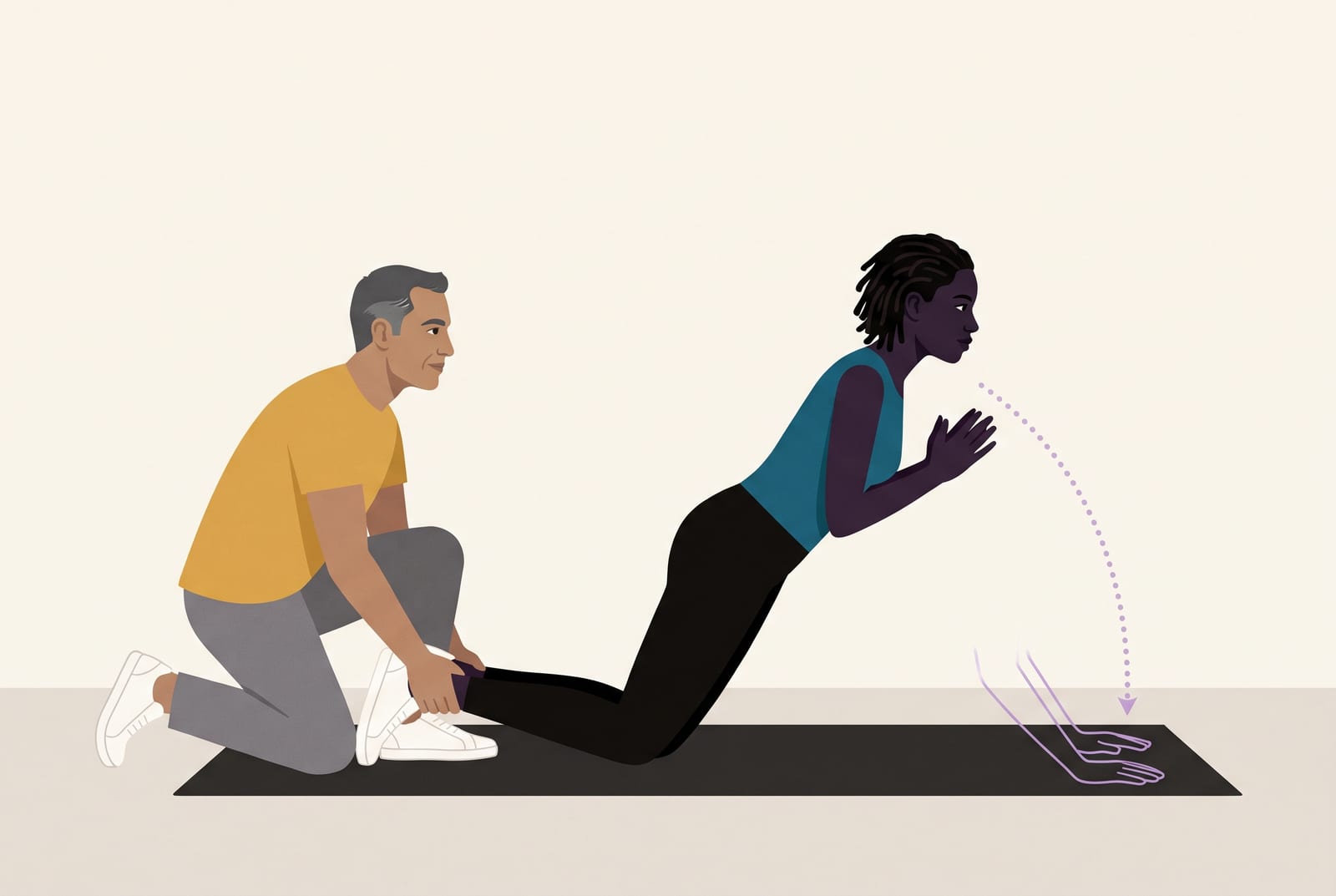
Kneel on a folded mat with a partner holding your ankles firmly to the floor, or hook your heels under something solid that will not move. Then:
- Keep a straight line from knees to shoulders. Squeeze your glutes so you do not fold at the hips.
- Lower forward as slowly as you can, resisting with your hamstrings.
- When you can no longer hold the position, catch yourself with your hands in a push-up position.
- Push gently off the floor to return upright. Beginners do not need to pull themselves back up with the hamstrings alone.
A quick pre-session checklist
- Have I warmed up with at least 5 to 10 minutes of easy movement?
- Is my sprint session or match at least two days away?
- Has soreness from the last session faded?
- Is the mat thick enough that my kneecaps are comfortable?
- Is my anchor (partner or fixed object) truly solid?
If any answer is no, swap the day or drop a set. Missing one session costs far less than quitting the programme.
When should you hold back?
If you have a fresh hamstring strain, this is not the time to start Nordics. Follow sensible early care, such as the steps in our post on the RICE approach to a new injury, and let a physical therapist decide when eccentric loading fits into your rehab. Sharp pain during the lowering phase, rather than general effort or muscle burn, is a signal to stop and get assessed.
Where does compression fit in?
Compression is not a substitute for building strength, and the Nordic curl does the heavy lifting here. Some athletes coming back from a hamstring strain do like the feel of firm, even support around the thigh during sprint work, and our science page covers what research says about compression.
If you go that route, fit matters more than most people expect. In our made-to-measure work, the common problem with off-the-shelf shorts is a leg hem that rolls or a band that digs in where the thigh is fullest, which leaves uneven pressure exactly where you want it smooth. Measure your thigh standing relaxed, at its widest point and just above the knee, and at the same time of day each time. That is the reasoning behind our custom compression shorts, which are cut to those measurements so the support stays where it belongs while you train.
The main point stays the same: a few slow, controlled Nordic reps, once or twice a week, every week, is one of the best-supported habits in hamstring injury prevention.