
Most separated shoulders heal without surgery, and the timeline depends mainly on the grade. A mild (grade I) separation usually settles in about 2 to 4 weeks, a grade II in roughly 4 to 6 weeks, and a grade III in about 6 to 12 weeks, with contact sport and heavy lifting typically held back until around 8 to 12 weeks. Higher grades (IV and V) took about four to five months on average in one large review.
What is a separated shoulder, exactly?
A separated shoulder is an injury to the acromioclavicular (AC) joint, where the collarbone meets the top of the shoulder blade. It is not a dislocated shoulder, which involves the ball-and-socket joint. AC injuries usually come from a fall or hit directly onto the point of the shoulder.
According to the American Physical Therapy Association guide shared by Pro Dynamic Physical Therapy, these injuries are most common in people under 35, and men sustain five times more traumatic AC injuries than women. Football, cycling, skiing and hockey carry the highest risk.
Doctors grade the injury from I to VI (the Rockwood system):
- Grade I: the ligaments around the joint are stretched, with no real shift in position.
- Grade II: the joint ligament tears and the collarbone may sit slightly higher.
- Grade III: a complete separation. The Steadman Clinic describes it as tearing of the AC ligament, the coracoclavicular ligaments and the joint capsule, usually with an obvious bump.
- Grades IV to VI: the collarbone is pushed far out of place. These are rarer and traditionally treated with surgery, though recent trials suggest some grade IV and V injuries do well without it.
How long does each grade take to heal?
Clinic timelines line up closely. Propel Physiotherapy gives these ranges:
| Grade | Typical recovery |
|---|---|
| I | 2 to 4 weeks |
| II | 4 to 6 weeks |
| III | 6 to 12 weeks |
A 2025 systematic review of return to sport after AC injury, pooling 25 studies and 1,077 patients, found that 90.8% of athletes got back to sport and 87.7% returned to their pre-injury level. Average return times rose with severity: about 83 days for grade III, 122 days for grade IV and 140 days for grade V. The figure for grades I and II (about 20 days) came from a single small study, so treat it as a rough guide only.
The Steadman Clinic puts the overall window of disability at "a few days to 12 weeks depending on the severity of the separation."
How long should you wear a sling?
Sling time is shorter than many people expect. A review in Orthopedic Reviews gives 7 to 10 days for a grade I and up to 4 to 6 weeks for a grade II, with rehab starting once immobilisation ends and symptoms settle. The Steadman Clinic says the sling is usually needed for about 1 to 2 weeks, until pain subsides, and Kinetic Labs notes that rigid taping can ease symptoms as you come out of the sling.
In the first days, ice and relative rest ease pain and swelling; our post on the RICE approach covers the basics.
Does starting rehab early speed things up?
It seems to, though the evidence is not airtight. In the 2025 review, programmes that began strengthening within six weeks were linked to faster return to sport (93 versus 132 days) and a higher rate of getting back to pre-injury level (86.8% versus 72.7%). The authors caution that studies varied widely, so other factors may explain part of the gap.
A typical progression runs like this:
- Protect (week 0 to 2): sling as needed, gentle elbow, wrist and hand movement.
- Restore motion (week 1 to 6): pendulum swings, assisted reaching, shoulder blade control.
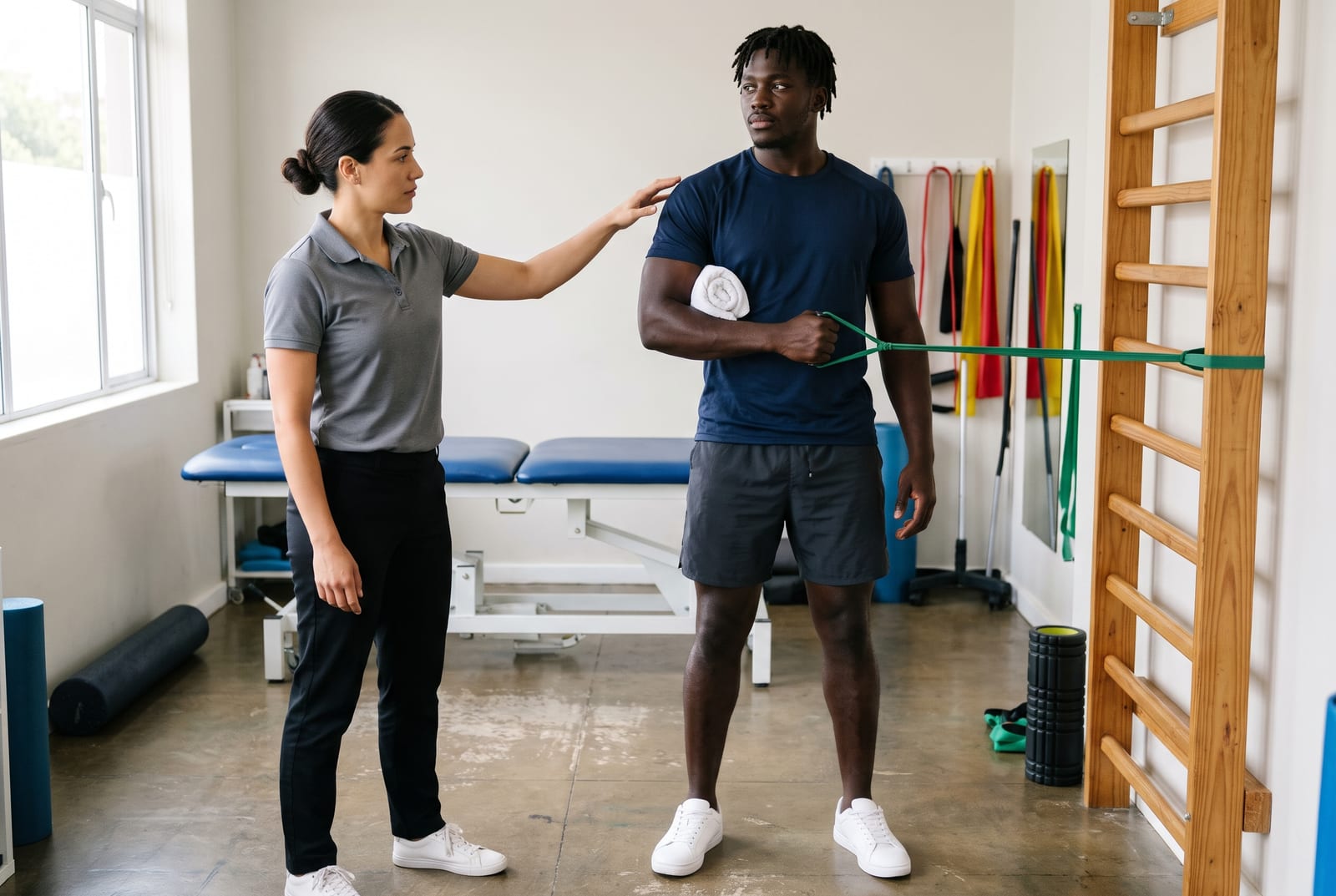
- Build strength (from about week 3 to 6): rotator cuff and scapular work with bands, then light pressing and pulling.
- Return to load (week 6 to 12+): heavier lifting, overhead work, then sport-specific drills and contact.
The Orthopedic Reviews authors advise waiting 8 to 12 weeks from injury before contact sport or weightlifting.
Do grade III separations need surgery?
Usually not at first. A 2011 meta-analysis on grade III injuries found that surgery gave a better cosmetic result but longer sick leave, with no difference in strength, pain, throwing ability or arthritis. All six included studies were low-quality case series, so the authors could not name a clear winner.
Stronger evidence has arrived since. A meta-analysis of randomised trials covering grades III to V found no difference in shoulder function scores at one year or more. Non-surgical care gave better early results and an earlier return to work. The authors concluded that starting non-surgically is a reasonable approach for most patients. Surgery remains an option if the shoulder stays painful or unstable.
The bump over a grade III joint usually stays, but it is mostly cosmetic.
When is it safe to lift or play again?
Time is only part of the answer. Before returning to contact sport or heavy lifting, work through this checklist with your physical therapist:
- You can sleep on the injured side without waking from pain.
- Overhead reach and reaching across your body are full and pain-free.
- Pressing on the top of the joint causes little or no tenderness.
- Strength matches the other side in push-ups, band rotations and overhead holds.
- You have completed sport-specific drills (falling, tackling, catching, bar work) without symptoms the next day.
- Dips, bench press and overhead press, which load the joint most, come back last and start light.
What about bracing when you return?
Early on, the sling does the protecting. Later, many athletes going back to collision sport want protection over the point of the shoulder. A brace can add impact absorption and security there, but it will not tighten torn ligaments or replace the strength work above. We summarise what the research says about compression and support on our science page.
Making garments to measure has taught us a few things about fit after an AC injury:
- Measure late, not early. Swelling and muscle loss in the first weeks change the shape of the shoulder and upper arm. Measure once swelling has settled.
- Measure relaxed. Take chest and upper arm measurements with the arm hanging at your side, not flexed or raised.
- Check pressure over the joint. Firm, even support is the goal. If a brace digs into the tender point at the top of the shoulder, it needs adjusting.
Our BodyGuard Angle Compression Shoulder Brace is made to each person's measurements for this kind of impact-related shoulder injury. Clear its use with your therapist as part of the final return-to-sport stage.
The bottom line
Expect weeks for mild grades and around three months for complete separations. A short spell in a sling, guided strength work within the first six weeks and a test-based return to contact give you the best chance of a full comeback.