
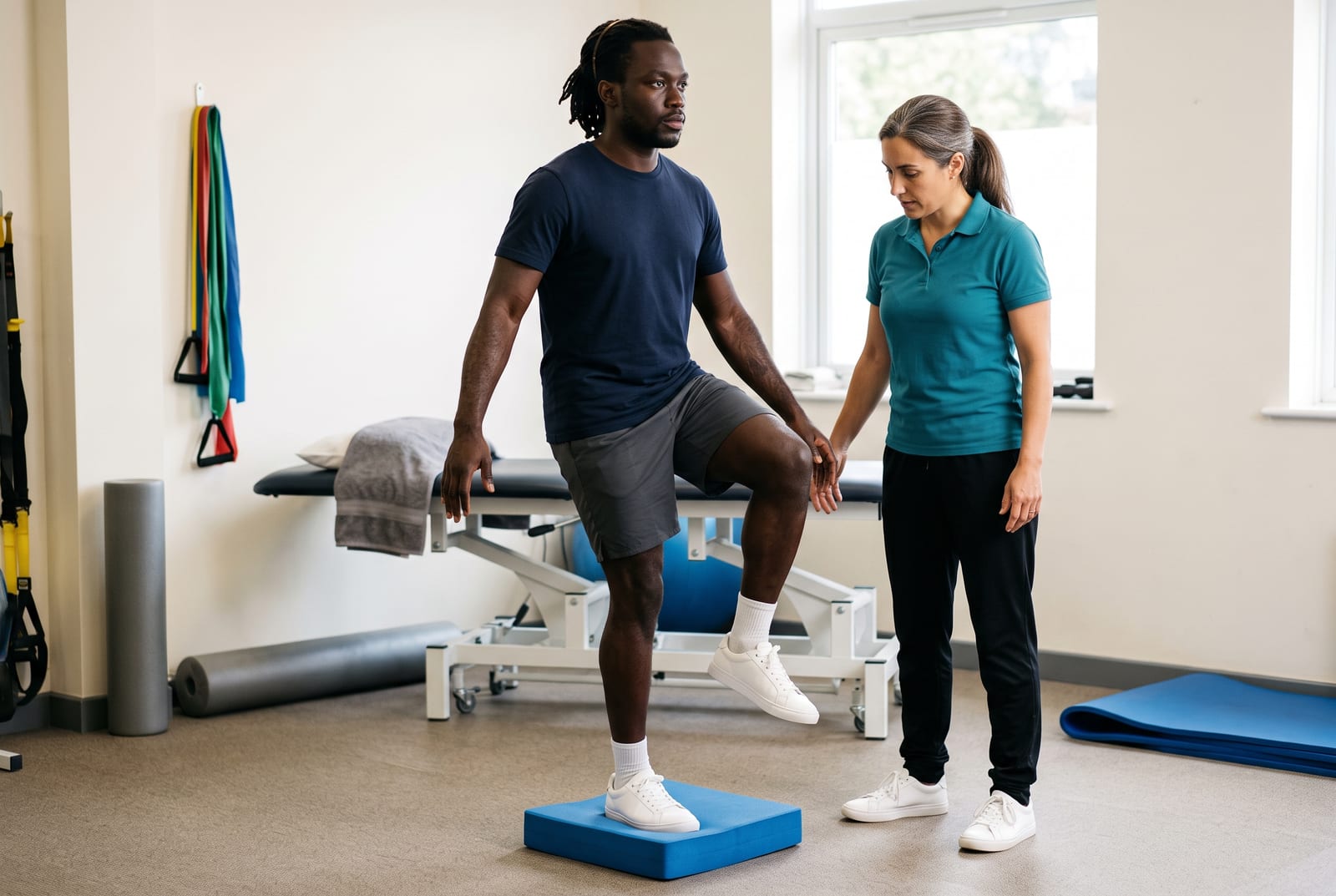
Most people can return to sport somewhere between one and eight weeks after a lateral ankle sprain, depending on how badly the ligament was damaged. The calendar is only a rough guide, though. The better answer is that you are ready when the ankle passes a set of function checks: little or no pain in sport, near-normal motion and strength, good balance, and confidence in the joint.
How long does each grade of ankle sprain usually take?
Ankle sprains are graded by how much the ligament is stretched or torn. The American Academy of Family Physicians gives these typical recovery times:
- Mild (stretching or tiny tears): 1 to 2 weeks
- Moderate (partial tear): 2 to 4 weeks
- Severe (complete tear): 6 to 8 weeks
- High ankle sprain (the ligaments between the two shin bones): 8 to 12 weeks on average
Other sources give slightly longer ranges. Harvard Health puts a grade 1 sprain at 1 to 3 weeks and a grade 2 at 3 to 6 weeks. Treat these numbers as ballpark figures, not deadlines. The grade itself is often a best guess made while the ankle is still swollen.
Why isn't time alone a good enough test?
Because ankle sprains come back. Physio Network's summary of the research notes that up to one third of people who sprain an ankle go on to have symptoms of chronic ankle instability within the next 12 months. The AAFP explains that this ongoing instability can develop when people skip enough rehab, and that pain and swelling can linger if you get active too soon.
It is worth being honest about the evidence here. A 2026 paper comparing research frameworks with the protocols of elite teams points out that a 2019 systematic review found no evidence-based criteria for return-to-sport decisions after a lateral ankle sprain, and that teams still assess athletes in patchy, inconsistent ways. So nobody can hand you a validated pass mark. What we do have is expert consensus.
What do sports medicine experts check before clearing you?
In 2021 the International Ankle Consortium published the PAASS framework in the British Journal of Sports Medicine. It came from a three-round Delphi survey of 155 health professionals working in elite field and court sports. Their 16 assessment items were grouped into five areas:
- Pain during sport and over the past 24 hours
- Ankle impairments such as range of motion, strength, endurance and power
- Athlete perception: confidence, sense of instability, readiness
- Sensorimotor control: balance and control of the joint
- Sport and functional performance: the movements your sport actually asks for
PAASS moves the question away from "how many weeks has it been?" and towards "what can this ankle do?" It is a consensus framework rather than a tested formula.
What should rehab look like in the first few weeks?
Early, protected movement beats long periods in a cast or boot for most sprains. A Cochrane review comparing immobilisation with functional treatment (early movement with support from a brace or tape) concluded that functional treatment appears to be the better strategy, and none of its analyses favoured immobilisation. The authors did advise caution: many trials were poorly reported, and several differences disappeared once the weaker studies were removed.
Severe sprains are a partial exception. The AAFP suggests a rigid stirrup brace or walking boot for up to 10 days in those cases, while noting that most people will be told to start moving again within that time. For the first couple of days, our guide to the RICE approach covers the basics. After that, the work turns to range of motion, calf and hip strength, and balance. Our post on whether balance training prevents ankle sprains explains why that last part matters so much.
A return-to-sport self-check
This is not the formal PAASS test, which a clinician should run. It is a practical way to tell whether you are ready to ask for that assessment. Go through it in the shoes you play in:
- Pain: You can walk, jog and climb stairs with no pain, and the ankle is not sore or puffier the next morning.
- Motion: In a lunge facing a wall, the injured knee travels about as far past the toes as the uninjured one.
- Strength: You can do as many slow single-leg calf raises on the injured side as on the good side.
- Balance: You can stand on the injured leg, eyes open, for 30 seconds without grabbing for support, and it feels about as steady as the other side.
- Hops and cuts: You can hop forwards and side to side on the injured leg, then jog figure-eights and gentle cuts, without pain or hesitation.
- Confidence: You are not guarding the ankle or thinking about it with every step.
If any item fails, keep working on it rather than playing through it. Return gradually: training before matches, partial sessions before full ones.
Should you wear a brace when you go back?
For people coming back from a sprain, this is where the evidence is fairly solid. A 2018 meta-analysis in Sports Medicine found that ankle bracing is effective for secondary prevention, meaning preventing a repeat sprain, with moderate-quality evidence from randomised trials. The AAFP advises wearing a brace or tape for 12 months during high-risk sports to lower the risk of re-injury.
Brace or tape? One non-randomised trial of 157 adults found similar one-year re-injury rates after four weeks of either: 17% with a soft brace and 14% with tape, a difference that was not statistically meaningful. In practice, the best option is the one you will wear properly every session. A brace supports the ankle while your strength and balance catch up. It does not replace the rehab, and it does not guarantee you won't sprain it again.
A fitting tip from made-to-measure work
Building braces to individual measurements has taught us that timing matters. An ankle measured while it is still swollen gives a brace that feels snug in week one and loose by week six, just when you are cutting and landing again. Measure once the swelling has mostly settled, at the same time of day, wearing the sock you train in. Then check the fit inside your actual sport shoe. If you want a closer fit than a sized sleeve gives, our BodyGuard compression ankle brace is made to your measurements for that reason. You can read more about what research says on compression and support on our science page.
When should you see a professional?
Get the ankle checked if you cannot put weight on it, the pain is severe, the swelling is not settling after a few days, or it keeps giving way weeks later. A physical therapist can run the PAASS-style checks properly and build a return plan around your sport.