
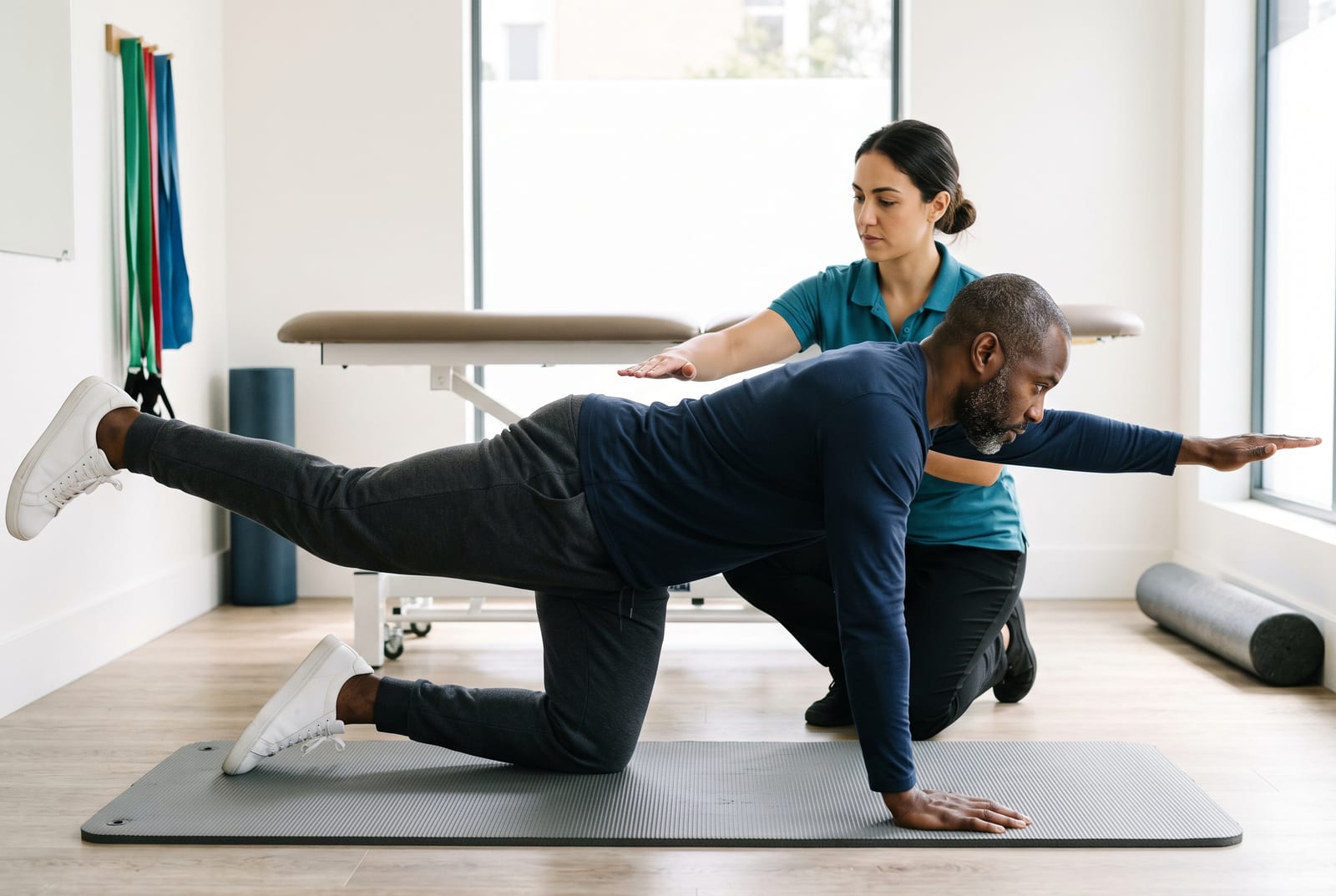
For most people, no. Research so far has not shown that wearing a back brace for a few weeks makes your trunk muscles waste away or lose strength, and several trials found strength and muscle size unchanged after a month of daily use. The real risk is quieter: leaning on the brace instead of rebuilding movement and strength, which is why a brace works best as one part of a plan rather than the whole plan.
Where does the "brace makes your core weak" idea come from?
The logic sounds reasonable. If a brace takes over some of the work, your muscles do less, and muscles that do less tend to shrink.
A brace does change how your spine moves. A systematic review of 33 studies found that lumbar supports reduce trunk motion when bending forward, backward and to the side. The same review, though, found no evidence that they reduce the electrical activity of the erector spinae, the long muscles running up your back. Limiting motion is not the same as switching muscles off.
There is also an older study behind the worry. In a 1996 study of 24 people, people with back pain who had worn a lumbar orthosis for a long time showed weaker trunk flexion and extension than matched controls. The groups were tiny (six people each) and the study was not randomized, but the authors' advice still makes sense: limit how long you wear it when you can, and add strengthening if you expect to wear it for a long stretch.
What does the research actually show?
The better studies since then point in a reassuring direction:
- A 2017 systematic review of 35 studies found that most research on trunk muscle activity showed a decrease or no change with a brace, and a few showed an increase. The authors found no conclusive evidence that braces cause trunk muscle weakness.
- A 2019 randomized trial of 44 people with chronic low back pain had one group wear a non-stretch brace for an average of 7.21 hours a day for four weeks alongside physical therapy. Ultrasound showed no change in the thickness of the deep stabilizers: transversus abdominis, internal oblique and lumbar multifidus.
- Another 2019 trial of 48 people with chronic low back pain compared soft braces with no brace over four weeks. Strength, endurance and most muscle activity measures were unaffected, while disability and body-position sense improved more in the brace groups.
- A 2026 systematic review of 11 randomized trials with 691 participants concluded that current evidence does not show brace-induced muscle atrophy or functional decline.
How strong is that evidence?
Modest, and it is fair to say so. Most trials are small, most last about four weeks, and most involve people with chronic non-specific low back pain rather than athletes coming back from a strain. The 2026 review also noted that side effects, how consistently people wore their braces, and comfort were not reported consistently. So "no sign of weakness after a month" is well supported. "Harmless no matter how long you wear it" has not been tested properly.
So what is the real risk?
It is mostly about behaviour, not biology. The brace becomes the default: on from breakfast to bedtime, worn on the sofa, and treated as the thing that keeps your back safe. Over time you may start avoiding movements you are perfectly capable of, and the strength and confidence you need to go without it never get rebuilt.
That pattern is easy to avoid once you know to look for it.
How do you wear a back brace without losing strength?
A practical checklist:
- Give each session a reason. Lifting, a long drive, a shift on your feet, or a flare-up are good reasons. Watching television or sleeping usually are not.
- Keep training alongside it. Core and hip work set by your physical therapist should run in parallel with the brace, not start after it. Our overview of how rehabilitation progresses explains how the stages fit together.
- Taper on purpose. As pain settles, cut the hours first, then the activities. For example, keep it for heavy lifting after you have stopped wearing it for walking.
- Notice dependence. If you feel you cannot move without it weeks after the pain has eased, raise that with your therapist. It is a confidence and loading question they can help with.
- Snug, not crushing. In the 2019 soft-brace trial, people who wore their brace at higher pressure did somewhat better on motor function. That was one small study, so do not take it as a reason to crank the straps. Tingling, numbness, trouble breathing deeply or deep red marks on your skin mean it is too tight.
Does fit change how a brace works?
Yes, and this is where our made-to-measure work has taught us the most. An off-the-shelf brace that is a little too big tends to ride up, so people pull one strap harder to hold it in place. That concentrates pressure in one band instead of spreading it around the trunk. One that is a little too small digs into the hips or lower ribs, quickly gets uncomfortable, and ends up in a drawer.
A brace cut to your own measurements spreads compression more evenly and stays where it is put. That is the thinking behind our made-to-measure BodyGuard compression back brace. If you are measuring yourself for any brace:
- Stand relaxed and measure after a normal breath out, without sucking in.
- Keep the tape level and snug against your clothing or skin without pressing into it.
- Measure at the height where the brace will actually sit, usually around the navel and across the top of the hip bones.
- Measure twice, at the same time of day. If the two numbers differ, take a third measurement.
For more on what research says about compression and support in general, see our science page.
When is a brace the wrong tool?
A brace supports a back while it recovers. It does not diagnose anything. If pain is getting worse rather than better, spreads down a leg with numbness or weakness, or followed a fall or a heavy impact, get it assessed before you rely on any support. The same goes if you are still reaching for the brace every day after several weeks: that is a good moment to check in with a physical therapist and adjust the plan.
Used with a reason, fitted well and paired with steady strength work, a back brace is unlikely to leave your core weaker. It can give you the support you need to keep training while your back recovers.